
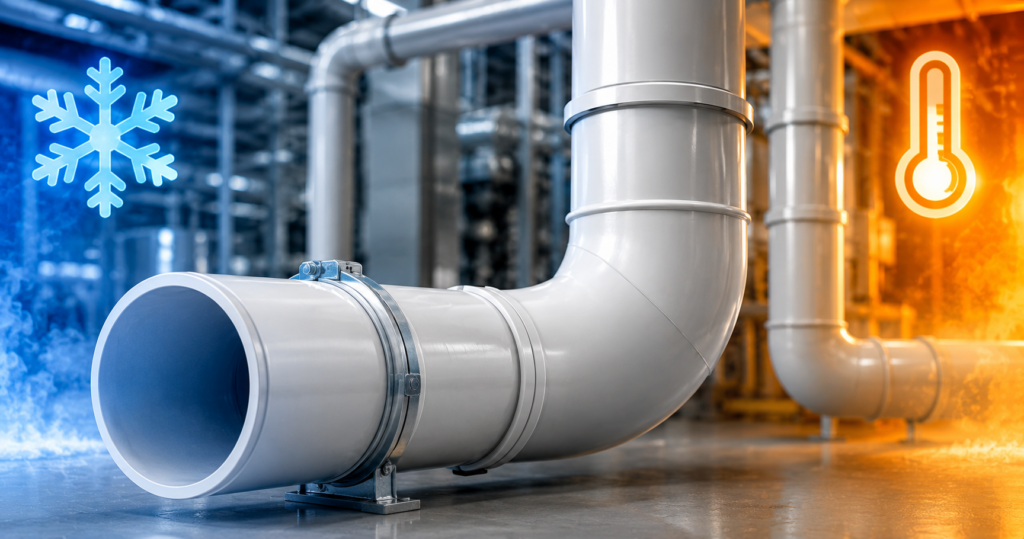
PVC is the workhorse of corrosion-resistant exhaust — but only within its thermal envelope. Push it past that ceiling and its mechanical properties fall off quickly.
The single number worth memorizing: standard PVC handles continuous service to about 140°F (60°C). That figure assumes steady-state operation. As temperature climbs toward the limit, PVC’s stiffness and pressure rating drop, which is why designing to the average stream temperature is a common and costly mistake.
The numbers that matter
| MATERIAL | MAX CONTINUOUS SERVICE TEMP. | TYPICAL USE |
|---|---|---|
| PVC | ~140°F (60°C) | Ambient / moderate corrosive exhaust |
| CPVC | ~200°F (93°C) | Hot or aggressive process exhaust |
Watch the peaks, not the average
Rated service temperatures describe continuous duty. Short excursions above the limit — during a process upset, a steam clean, or a summer afternoon in an uninsulated space — can still deform PVC. A run that averages 120°F but spikes to 160°F is a CPVC application, not a PVC one.
Derating is real.
PVC’s allowable pressure decreases as temperature rises. If your run sees both heat and internal pressure or strong vacuum, confirm the derated rating — don’t rely on the room-temperature spec.
Signs a run has exceeded its limit
- Visible sag between supports, or duct that has gone slightly out-of-round.
- Joint distortion or weakened welds near the hottest section.
- Softening that lets fittings such as elbows or dampers shift under load.
When to step up to CPVC
If the worst-case temperature approaches or exceeds 140°F, CPVC’s roughly 200°F ceiling is inexpensive insurance. For the full trade-off across materials — including FRP for large or high-strength cases — see PVC vs. CPVC vs. FRP. Support spacing also tightens as temperature rises, so revisit hanger intervals whenever a run operates near its ceiling.