

pdiduct.com

Home > resource > How Do You Size Fume Hood Exhaust Duct?

How Do You Size Fume Hood Exhaust Duct?

PDI Engineering Team

Plastic Design Industries

Start from the hood's required exhaust volume in CFM, set by the face velocity across the sash opening — typically 80–120 fpm. Then size the duct so transport velocity stays high enough to carry the exhaust, usually 1,000–2,000 fpm for vapors and higher for particulate. The duct diameter is whichever size delivers the target CFM at that velocity. Finally, verify total static pressure against the fan curve.
Related Products

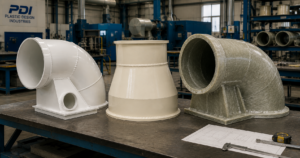
90° Elbows

Directional fittings

End Caps

End sealing

45° Elbows

PVC & CPVC fittings

Reducers

Transitions & terminations

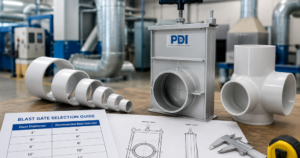
Blast Gates

Flow isolation & balancing

Get a Quote

Spec it right the first time

Send us your temperature, chemistry, and size requirements. We'll respond with a recommendation within one business day.

Browse Guides

Sizing lab exhaust duct is a chain of three linked numbers: how much air the hood needs, how fast that air must move, and the diameter that satisfies both.

Step 1 — Find the required CFM

A fume hood’s exhaust volume is governed by face velocity — the average air speed drawn through the sash opening. Most labs target 80–120 feet per minute (fpm). Multiply face velocity by the open sash area to get the required volume:

  • CFM = face velocity (fpm) × sash opening area (ft²).
  • Example: 100 fpm across a 6 ft² opening ≈ 600 CFM.

Step 2 — Set the transport velocity

Once you know the volume, the duct has to move it fast enough that vapors — and any entrained particulate — stay in suspension. Too slow and condensable fumes or dust settle out inside the run.

TYPICAL TRANSPORT VELOCITIES – CONFIRM FOR YOUR PROCESS
EXHAUST TYPE TARGET TRANSPORT VELOCITY
Gases & vapors 1,000–2,000 fpm
Fumes / light smoke 2,000–2,500 fpm
Fine dust / particulate 3,000–4,000+ fpm

Step 3 — Solve for diameter

Duct area equals volume divided by velocity: A (ft²) = CFM ÷ velocity (fpm). Convert that area to a round-duct diameter and round up to the nearest standard size. Continuing the example: 600 CFM at 1,500 fpm needs 0.4 ft², which is about an 8‑inch duct.

Round up, then re-check velocity.

Bumping to the next standard diameter lowers the actual transport velocity. Confirm the rounded-up size still keeps velocity above your minimum, especially on particulate-laden exhaust.

Step 4 — Verify static pressure

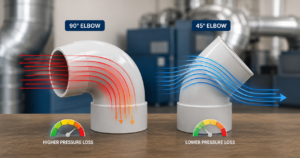
Add up the losses — straight duct friction plus every fitting. Turns matter: see 90° vs. 45° elbow pressure loss for how to keep them low. The total static pressure at the design CFM must land within the selected fan’s curve, with margin for filter loading and future changes.

  1. Confirm the material suits the chemistry and temperature — PVC for ambient corrosive lab exhaust, CPVC when hot.
  2. Minimize fittings and use gentle turns to protect your static-pressure budget.
  3. Balance branches with correctly sized blast gates so each hood pulls its design airflow.

For manifolded multi-hood systems, balancing and redundancy add complexity worth reviewing with a fabricator before the ducts are built.

Not sure which material
your application calls for?

Send us the temperature, chemistry, and size requirements — a PDI
engineer will recommend the right material and fabrication approach.

Not sure which material your application calls for?

Send us the temperature, chemistry, and size requirements — a PDI engineer will recommend the right material and fabrication approach.

Keep Reading
Related Guides
CSSI Logo
A Division of Plastic Design Industries
Chemical Systems Services, Inc.

Custom plastic environmental control and containment equipment, fabricated in corrosion-resistant thermoplastics.

Company Overview

Chemical Systems Services, Inc. (CSSI) is a leading custom designer and manufacturer of plastic environmental control and containment equipment, fabricating corrosion-resistant systems from thermoplastics including polypropylene, PVC, CPVC, and PVDF.

Capabilities & Products

An experienced staff of chemical engineers and designers builds systems to each client’s specifications. The range includes PVC and CPVC fittings, blast gates and dampers, scrubbers, fume hoods, tanks and sinks, containment trays, and casework — most fittings stocked for fast delivery, all made in America.

Plastic Design Industries
Plastic Fabrication & Engineering
Plastic Design Industries

New England’s oldest and largest plastic fabrication house — engineered systems from prototype to full production.

Company Overview

Plastic Design Industries (PDI) uses the unique properties of modern engineering plastics to supply systems and products for industries from biomedical and pharmaceutical to microelectronics and photonics. With automated fabrication equipment and expert computer-aided design, PDI supplies any quantity — from a one-off prototype to a full production run.

Capabilities & Services

PDI takes projects from concept to completion — design, engineering, testing, and validation — spanning cleanroom essentials, fume hoods, wet-process equipment, custom tanks, lab furniture, pure-fluid (PFA) assemblies, casework, and precision welding and machining. ISO 9001 accredited and made in the USA.