
pdiduct.com

Home > resource > How Do You Select and Size a Blast Gate?

How Do You Select and Size a Blast Gate?

PDI Engineering Team

Plastic Design Industries

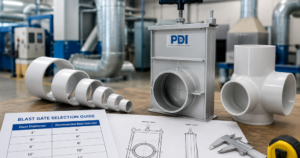
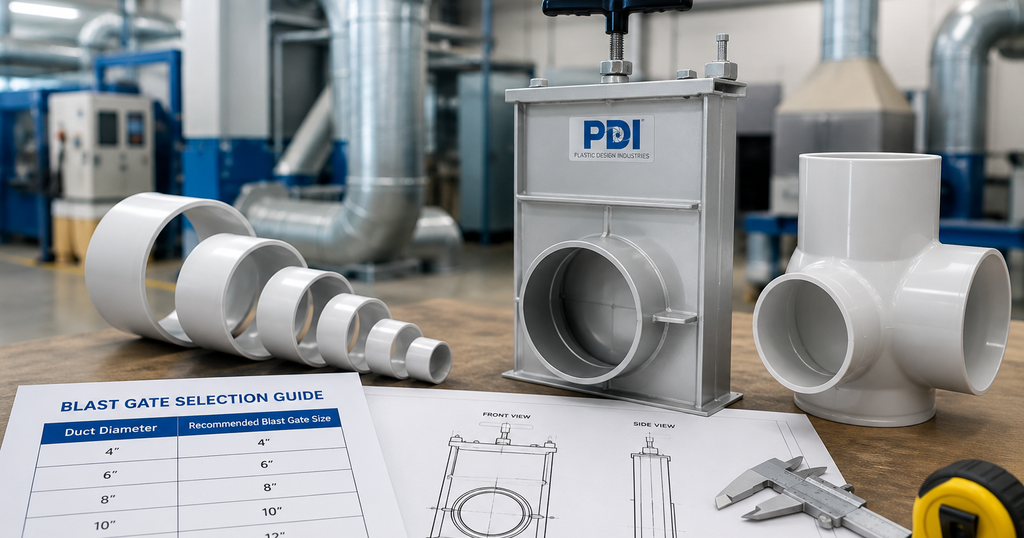
Match the blast gate's diameter to the duct branch it serves so it doesn't restrict flow, and choose a type — manual or pneumatic — based on how often the branch is isolated. Size for the transport velocity the branch needs, often 3,500–4,500 fpm for dust, so material stays entrained. For tight tie-ins on an existing main, a saddle-mount gate avoids cutting a full tee.
Related Products

90° Elbows

Directional fittings

End Caps

End sealing

45° Elbows

PVC & CPVC fittings

Reducers

Transitions & terminations

Blast Gates

Flow isolation & balancing

Get a Quote

Spec it right the first time

Send us your temperature, chemistry, and size requirements. We'll respond with a recommendation within one business day.

Browse Guides

A blast gate is simple hardware with an outsized effect on a system: sized and placed well, it balances airflow; sized poorly, it starves branches or lets material settle and plug the run.

Match the diameter to the branch

The first rule is the simplest: the gate should match the diameter of the branch it serves. An undersized gate becomes a restriction that robs the branch of airflow and drives up static pressure; an oversized one drops velocity below the point where dust stays airborne.

Hold the transport velocity

In dust-collection and particulate exhaust, the branch must maintain enough velocity to keep material entrained. Fall below it and solids drop out, accumulate, and eventually block the duct.

TYPICAL TRANSPORT VELOCITIES – CONFIRM FOR YOUR MATERIAL
MATERIAL TARGET VELOCITY
Vapors / light fumes 1,500–2,000 fpm
Fine, dry dust 3,000–3,500 fpm
Average industrial dust 3,500–4,500 fpm
Heavy or moist material 4,500+ fpm

Choose the gate type

  • Manual gates suit branches that are opened or isolated infrequently, or set once during balancing.
  • Pneumatic gates suit branches cycled often or automated with the collector, so the fan only pulls where it’s needed.
  • Saddle-mount gates add or isolate a branch on an existing main without cutting a full tee — ideal for retrofits and tight tie-ins.

Placement affects balance.

Leave a few diameters of straight duct upstream and downstream of the gate. Crowding it against elbows or tees creates turbulence that undermines both flow and measurement.

Balance the whole system

Blast gates balance a network only when every branch is sized around a common transport-velocity target. Set each gate so its branch pulls its design share, then verify total static pressure against the fan curve — the same discipline used when sizing fume-hood exhaust duct.

  1. Size each branch for its required CFM at the target velocity.
  2. Match gate diameter to each branch.
  3. Set and lock the gates during balancing, then re-measure.

Not sure which material
your application calls for?

Send us the temperature, chemistry, and size requirements — a PDI
engineer will recommend the right material and fabrication approach.

Not sure which material your application calls for?

Send us the temperature, chemistry, and size requirements — a PDI engineer will recommend the right material and fabrication approach.

Keep Reading
Related Guides
CSSI Logo
A Division of Plastic Design Industries
Chemical Systems Services, Inc.

Custom plastic environmental control and containment equipment, fabricated in corrosion-resistant thermoplastics.

Company Overview

Chemical Systems Services, Inc. (CSSI) is a leading custom designer and manufacturer of plastic environmental control and containment equipment, fabricating corrosion-resistant systems from thermoplastics including polypropylene, PVC, CPVC, and PVDF.

Capabilities & Products

An experienced staff of chemical engineers and designers builds systems to each client’s specifications. The range includes PVC and CPVC fittings, blast gates and dampers, scrubbers, fume hoods, tanks and sinks, containment trays, and casework — most fittings stocked for fast delivery, all made in America.

Plastic Design Industries
Plastic Fabrication & Engineering
Plastic Design Industries

New England’s oldest and largest plastic fabrication house — engineered systems from prototype to full production.

Company Overview

Plastic Design Industries (PDI) uses the unique properties of modern engineering plastics to supply systems and products for industries from biomedical and pharmaceutical to microelectronics and photonics. With automated fabrication equipment and expert computer-aided design, PDI supplies any quantity — from a one-off prototype to a full production run.

Capabilities & Services

PDI takes projects from concept to completion — design, engineering, testing, and validation — spanning cleanroom essentials, fume hoods, wet-process equipment, custom tanks, lab furniture, pure-fluid (PFA) assemblies, casework, and precision welding and machining. ISO 9001 accredited and made in the USA.