
Every turn in a duct run costs static pressure. How much depends on the angle of the turn and how tightly the air is forced to change direction.
Pressure loss through a fitting is usually expressed as a loss coefficient (often written C or K) multiplied by the velocity pressure. The sharper the turn and the tighter the radius, the higher the coefficient — and the more fan energy the run consumes over its life.
Angle drives the loss
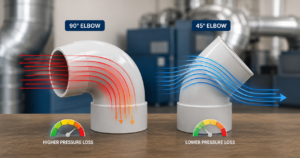
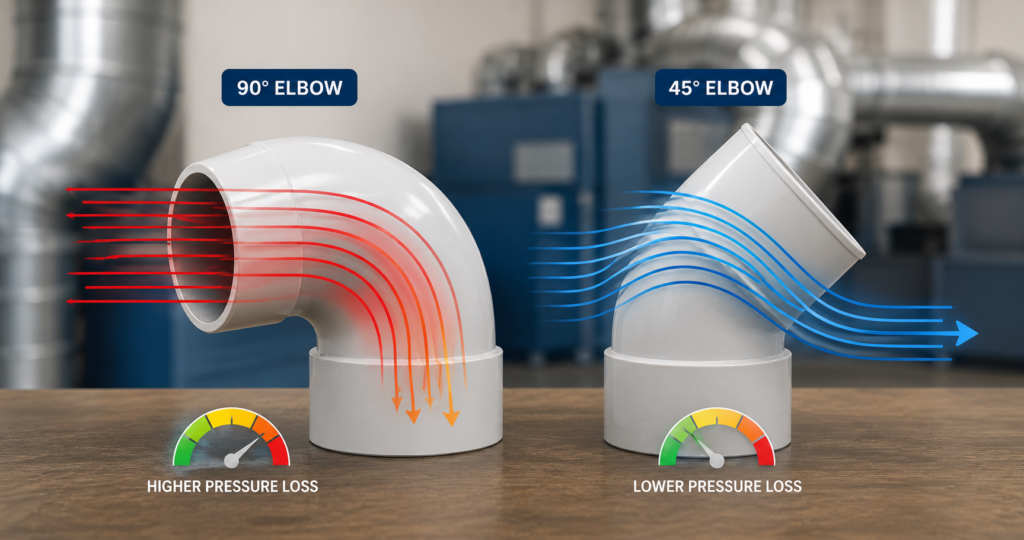
A 90° elbow turns the air a full quarter-circle in one fitting, forcing separation and turbulence along the inside of the bend. A 45° elbow turns it half as far, so the flow stays more attached and loses less energy. As a rule of thumb, a 45° elbow’s loss coefficient is well under half that of a comparable tight 90°.
| FITTING | RELATIVE STATIC LOSS | NOTES |
|---|---|---|
| Tight 90° elbow | Highest | Short centerline radius |
| Long-radius 90° | Lower | Larger radius smooths the turn |
| Two 45° elbows | Lower still | Split the turn, keep flow attached |
| Single 45° elbow | Lowest | Half the direction change |
Radius matters as much as angle
Centerline radius — how gently the bend sweeps relative to the duct diameter — has a large effect. A long-radius 90° can approach the performance of two 45s. When space is tight and a 90° turn is unavoidable, specifying a long-radius fitting is the cheapest way to recover pressure.
Don’t stack elbows.
Placing fittings back-to-back with no straight duct between them compounds turbulence and can exceed the loss of the individual parts. Give the flow a few diameters of straight run to re-develop.
Practical guidance
- Prefer 45s or long-radius turns wherever the layout allows.
- Replace one tight 90° with two 45s when routing around an obstruction.
- Leave straight duct between fittings and before fans and blast gates for stable flow.
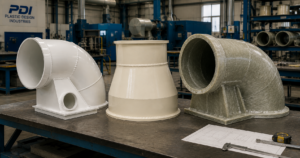
These choices add up across a system: lower total static pressure means a smaller fan, less noise, and lower energy cost. Our fabrication team stocks 45° elbows and can supply long-radius 90s to match your run.