How Do You Size Fume Hood Exhaust Duct?
Start from the hood's required exhaust volume in CFM, set by the face velocity across the sash opening — typically 80–120 fpm. Then size the duct so transport velocity stays…

Reference guides on specifying, sizing, and selecting PVC & CPVC duct systems — written by PDI’s engineering team for the engineers, contractors, and facility teams who build with them.
Start from the hood's required exhaust volume in CFM, set by the face velocity across the sash opening — typically 80–120 fpm. Then size the duct so transport velocity stays…

Start from the hood's required exhaust volume in CFM, set...
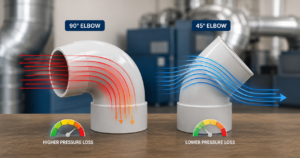
Read MoreA 90° elbow causes more pressure loss than a 45°...
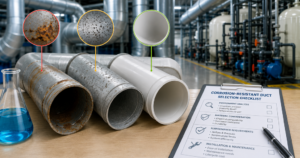
Read MoreMatch the material to the exhaust it will actually carry....
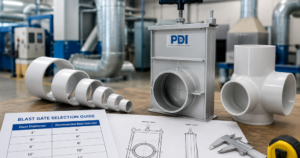
Read MoreMatch the blast gate's diameter to the duct branch it...
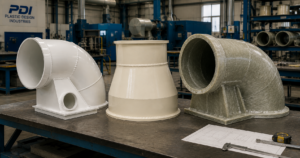
Read MoreStandard PVC duct carries a maximum continuous service temperature of...

Read MoreFor most corrosive exhaust below 140°F, PVC is the cost-effective...
Read MoreMatch the material to the exhaust it will actually carry....
Read MoreStandard PVC duct carries a maximum continuous service temperature of...
Read MoreFor most corrosive exhaust below 140°F, PVC is the cost-effective...
Read MoreNo posts found!
Start from the hood's required exhaust volume in CFM, set...
Read MoreA 90° elbow causes more pressure loss than a 45°...
Read MoreMatch the blast gate's diameter to the duct branch it...
Read MoreTypical response within one business day.

These guides cover the questions we hear most — but every corrosive exhaust system is different. Send us your temperature, chemistry, and size requirements and a PDI engineer will point you to the right material and fabrication approach.
Custom plastic environmental control and containment equipment, fabricated in corrosion-resistant thermoplastics.
Chemical Systems Services, Inc. (CSSI) is a leading custom designer and manufacturer of plastic environmental control and containment equipment, fabricating corrosion-resistant systems from thermoplastics including polypropylene, PVC, CPVC, and PVDF.
An experienced staff of chemical engineers and designers builds systems to each client’s specifications. The range includes PVC and CPVC fittings, blast gates and dampers, scrubbers, fume hoods, tanks and sinks, containment trays, and casework — most fittings stocked for fast delivery, all made in America.
New England’s oldest and largest plastic fabrication house — engineered systems from prototype to full production.
Plastic Design Industries (PDI) uses the unique properties of modern engineering plastics to supply systems and products for industries from biomedical and pharmaceutical to microelectronics and photonics. With automated fabrication equipment and expert computer-aided design, PDI supplies any quantity — from a one-off prototype to a full production run.
PDI takes projects from concept to completion — design, engineering, testing, and validation — spanning cleanroom essentials, fume hoods, wet-process equipment, custom tanks, lab furniture, pure-fluid (PFA) assemblies, casework, and precision welding and machining. ISO 9001 accredited and made in the USA.
pdiduct.com