
pdiduct.com

Home > resource > 90° vs. 45° Elbows: Which Causes More Pressure Loss?

90° vs. 45° Elbows: Which Causes More Pressure Loss?

PDI Engineering Team

Plastic Design Industries

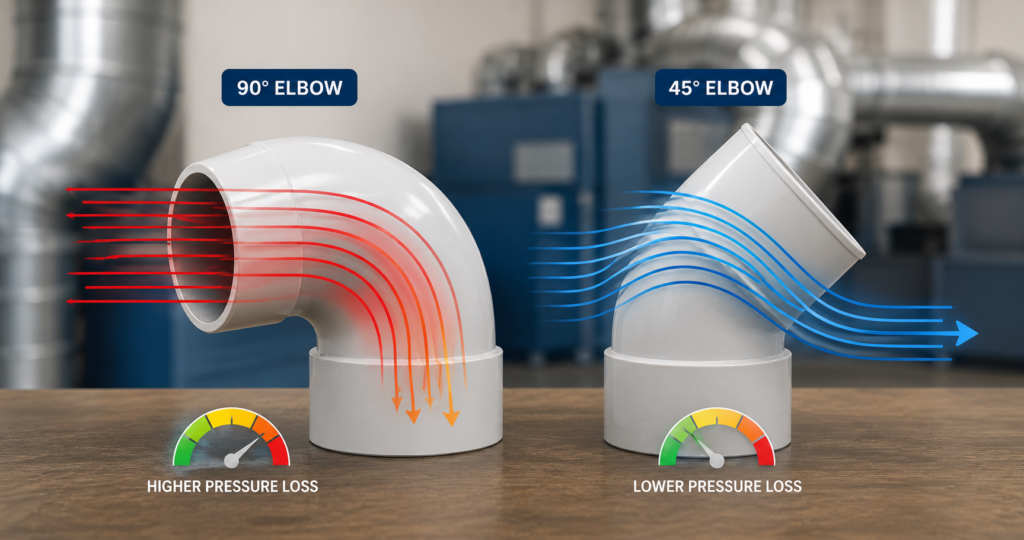
A 90° elbow causes more pressure loss than a 45° elbow because the airflow changes direction more sharply. Two 45° elbows spaced apart, or a single long-radius 90°, move the same air with less static loss than a tight 90°. Where the layout allows, favor gentler turns and larger centerline radii to cut fan energy, noise, and wear.
Related Products

90° Elbows

Directional fittings

End Caps

End sealing

45° Elbows

PVC & CPVC fittings

Reducers

Transitions & terminations

Blast Gates

Flow isolation & balancing

Get a Quote

Spec it right the first time

Send us your temperature, chemistry, and size requirements. We'll respond with a recommendation within one business day.

Browse Guides

Every turn in a duct run costs static pressure. How much depends on the angle of the turn and how tightly the air is forced to change direction.

Pressure loss through a fitting is usually expressed as a loss coefficient (often written C or K) multiplied by the velocity pressure. The sharper the turn and the tighter the radius, the higher the coefficient — and the more fan energy the run consumes over its life.

Angle drives the loss

A 90° elbow turns the air a full quarter-circle in one fitting, forcing separation and turbulence along the inside of the bend. A 45° elbow turns it half as far, so the flow stays more attached and loses less energy. As a rule of thumb, a 45° elbow’s loss coefficient is well under half that of a comparable tight 90°.

RELATIVE LOSS – DIRECTIONAL GUIDANCE, CONFIRM WITH FITTING DATA
FITTING RELATIVE STATIC LOSS NOTES
Tight 90° elbow Highest Short centerline radius
Long-radius 90° Lower Larger radius smooths the turn
Two 45° elbows Lower still Split the turn, keep flow attached
Single 45° elbow Lowest Half the direction change

Radius matters as much as angle

Centerline radius — how gently the bend sweeps relative to the duct diameter — has a large effect. A long-radius 90° can approach the performance of two 45s. When space is tight and a 90° turn is unavoidable, specifying a long-radius fitting is the cheapest way to recover pressure.

Don’t stack elbows.

Placing fittings back-to-back with no straight duct between them compounds turbulence and can exceed the loss of the individual parts. Give the flow a few diameters of straight run to re-develop.

Practical guidance

  • Prefer 45s or long-radius turns wherever the layout allows.
  • Replace one tight 90° with two 45s when routing around an obstruction.
  • Leave straight duct between fittings and before fans and blast gates for stable flow.

These choices add up across a system: lower total static pressure means a smaller fan, less noise, and lower energy cost. Our fabrication team stocks 45° elbows and can supply long-radius 90s to match your run.

Not sure which material
your application calls for?

Send us the temperature, chemistry, and size requirements — a PDI
engineer will recommend the right material and fabrication approach.

Not sure which material your application calls for?

Send us the temperature, chemistry, and size requirements — a PDI engineer will recommend the right material and fabrication approach.

Keep Reading
Related Guides
CSSI Logo
A Division of Plastic Design Industries
Chemical Systems Services, Inc.

Custom plastic environmental control and containment equipment, fabricated in corrosion-resistant thermoplastics.

Company Overview

Chemical Systems Services, Inc. (CSSI) is a leading custom designer and manufacturer of plastic environmental control and containment equipment, fabricating corrosion-resistant systems from thermoplastics including polypropylene, PVC, CPVC, and PVDF.

Capabilities & Products

An experienced staff of chemical engineers and designers builds systems to each client’s specifications. The range includes PVC and CPVC fittings, blast gates and dampers, scrubbers, fume hoods, tanks and sinks, containment trays, and casework — most fittings stocked for fast delivery, all made in America.

Plastic Design Industries
Plastic Fabrication & Engineering
Plastic Design Industries

New England’s oldest and largest plastic fabrication house — engineered systems from prototype to full production.

Company Overview

Plastic Design Industries (PDI) uses the unique properties of modern engineering plastics to supply systems and products for industries from biomedical and pharmaceutical to microelectronics and photonics. With automated fabrication equipment and expert computer-aided design, PDI supplies any quantity — from a one-off prototype to a full production run.

Capabilities & Services

PDI takes projects from concept to completion — design, engineering, testing, and validation — spanning cleanroom essentials, fume hoods, wet-process equipment, custom tanks, lab furniture, pure-fluid (PFA) assemblies, casework, and precision welding and machining. ISO 9001 accredited and made in the USA.