
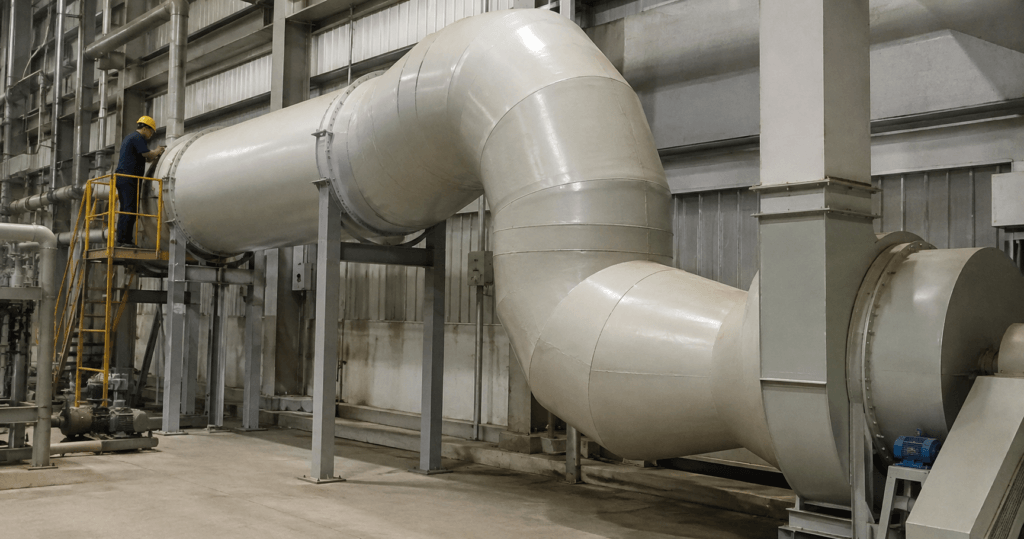
For corrosive exhaust systems that fit PVC’s service envelope, a custom-fabricated system can extend the advantages of thermoplastic duct into sizes and geometries that standard extruded duct cannot cover efficiently.
What Counts as Large-Diameter PVC Duct?
There is no single industry rule that says PVC duct becomes “large diameter” at a specific size. The better reference point is the standard product range available for the system being specified.
IPEX states that its seamless extruded PVC and CPVC ventilation duct is available in standard diameters from 6 inches through 24 inches. Spears publishes the same 6-inch-through-24-inch range for its seamless extruded PVC and CPVC duct. That makes 24 inches a useful product-range boundary for those two published standard lines, not a universal engineering definition of large-diameter duct.
A 24-inch duct may still be a standard product. A smaller duct with an unusual transition, offset, rectangular-to-round connection, equipment interface, or special wall requirement may still need fabrication. Conversely, a larger system may use a project-specific construction approach developed around the required diameter and operating conditions.
Why Custom Fabrication Becomes Relevant
Standard extrusion is efficient because the duct is produced as a repeatable seamless product with established dimensions. Once a project moves beyond those standard sizes or catalog geometries, the design may move to a custom-fabricated construction rather than a cataloged seamless extrusion. The exact fabrication method should be set by the fabricator and project requirements.
PDI lists oversize fabrication among its capabilities and describes built-to-spec PVC duct assemblies and fittings engineered to project requirements. That is the key distinction: the fabrication process becomes part of the engineering solution rather than simply a way to obtain a larger nominal diameter.
Custom fabrication can address:
- Diameters outside a standard extruded range.
- Nonstandard elbows, reducers, branches, transitions, and offsets.
- Connections to scrubbers, fans, hoods, stacks, or process equipment.
- Space constraints that require unusual geometry.
- Large assemblies that need to be broken into transportable sections.
- Project-specific wall construction, reinforcement, or support interfaces.
| Factor | Standard Extruded Duct | Custom-Fabricated Duct | What to Verify |
|---|---|---|---|
| Diameter | Published standard range 6–24 in. for IPEX/Spears | Can address nonstandard or oversize project requirements | Required diameter, OD/ID, connection method |
| Geometry | Standard duct and catalog fitting geometries | Custom elbows, reducers, branches, offsets, transitions | Equipment interfaces, layout, clearances |
| Construction | Seamless extruded construction | Built-to-spec fabricated assemblies | Wall construction, welds, reinforcement, temperature |
| Pressure / Stiffness | Use manufacturer data for the selected product | Requires a project-specific design basis | Maximum positive/negative static pressure, supports, loads |
| Transport / Installation | Standard lengths and catalog components | May require shipping sections and planned field assembly | Shipping limits, site access, rigging, field joints |
Diameter Alone Does Not Determine the Construction
The largest mistake in oversize duct specification is treating diameter as the only design input. A 36-inch duct carrying mild, room-temperature exhaust at low static pressure is a different structural problem from a 36-inch duct operating under higher negative pressure, elevated temperature, or heavy external component loads.
For custom PVC duct, the design review should consider diameter together with wall construction, unsupported span, operating pressure or vacuum, temperature, fittings, dampers, access doors, nozzles, and the way loads enter the duct. Larger diameters can require greater attention to wall stiffness and reinforcement under differential pressure, so the construction should be based on project-specific design data rather than diameter alone.
Custom fabrication should therefore begin with operating conditions, not with a request for “36-inch PVC duct” or “48-inch PVC duct” by diameter alone.
Negative Pressure and Structural Stiffness Matter
Industrial exhaust duct commonly operates under negative pressure. As duct diameter grows, resistance to buckling or ovalization becomes an important engineering consideration. The required construction can depend on diameter, wall thickness, material properties at operating temperature, reinforcement, support spacing, and the maximum credible system pressure.
This is also why pressure data from pressure piping or smaller standard products should not simply be assigned to an oversize fabricated duct assembly. Spears classifies duct fittings as NPR (non-pressure-rated) and separately notes that custom fabricated fittings and manifolds are manufactured to user specification and may not meet the same published requirements as standard products. A project-specific duct construction therefore needs its own design basis.
Engineers should provide the fabricator with normal operating static pressure and the maximum credible differential pressure, including fan shutoff, closed-damper, or upset conditions where those scenarios are applicable to the system.
Large Fittings Can Drive the Design
Large-diameter PVC ductwork is rarely just a long straight cylinder. Elbows, reducers, wyes, tees, blast gates, dampers, equipment transitions, and branch connections often determine the most difficult fabrication and support details.
A large reducer may introduce concentrated loads at a fan or scrubber connection. A large elbow may need different support than a straight run. A branch can create local geometry that requires careful fabrication and reinforcement. Airflow-control components can add weight and operating loads that should be supported without distorting the duct wall.
PDI manufactures PVC duct components including 90° elbows, reducers, wye branches, saddle blast gates, and butterfly dampers. On a large-diameter project, those components should be coordinated with the custom duct layout early rather than treated as standard accessories added after the main run is designed.
Temperature and Chemistry Still Set the Material Envelope
Custom fabrication does not extend PVC’s material limits. Spears publishes a maximum temperature rating of 140°F (60°C) for its extruded PVC duct, while CPVC is rated to 200°F (93°C). A custom-fabricated PVC assembly still needs to be evaluated against the actual material, fabrication method, manufacturer or fabricator data, and project conditions rather than assuming that a larger wall section raises the allowable service temperature.
The same applies to chemical resistance. The complete exhaust stream, concentration, condensate, cleaning chemicals, and peak temperature need to be compatible with PVC. PDI’s PVC duct temperature limits guide and PVC duct chemical resistance resource cover those two checks in more detail.
If a project requires a very large diameter, another material may deserve evaluation when structural demands, pressure or vacuum conditions, temperature, or other project requirements make PVC construction impractical. CPVC may be considered when higher temperature is the limiting factor; FRP or metallic construction may be considered when other service or structural requirements dominate. PDI’s PVC vs. CPVC vs. FRP material-selection guide is the better resource when diameter is only one of several competing material-selection factors.
Supports and Thermal Movement Become More Visible at Scale
PVC and CPVC ventilation duct are generally lightweight materials, but the actual weight of an oversize fabricated assembly depends on its wall construction and reinforcement. Light weight does not eliminate structural design: support spacing, hanger width, saddle design, concentrated loads, longitudinal movement, and thermal expansion still have to be coordinated with the duct construction.
Long runs can experience meaningful dimensional movement as temperature changes. Supports should restrain the duct where restraint is intended and allow movement where the system needs to expand or contract. Equipment connections should not become accidental anchors unless they are designed for those loads.
Large fittings and control components also deserve independent support where appropriate. The goal is to keep the duct round, aligned, and free from avoidable point loading throughout the operating range.
Transport and Field Assembly Can Shape the Design
A custom-fabricated section that can be built in the shop is not automatically practical to move through a plant, load onto a truck, pass through a doorway, or lift into position.
For oversized duct, shipping dimensions and installation access can influence where joints are placed and how assemblies are broken down. A large elbow or transition may need to ship in sections. Flanged or otherwise engineered field joints may be required where a fully shop-welded assembly would be too large to transport or rig safely.
That makes fabrication planning part of constructability. Before finalizing the duct geometry, confirm route access, crane or lift limitations, roof openings, equipment-room clearances, field-welding constraints, and the preferred sequence of assembly.
When Custom Fabrication Usually Makes Sense
Custom PVC duct fabrication deserves serious consideration when:
- The required duct diameter is outside the available standard extruded range.
- Standard fittings cannot match the equipment geometry or routing.
- A corrosive exhaust stream is compatible with PVC and within the allowable temperature range.
- Large reducers, branches, offsets, or equipment transitions are required.
- The system needs coordinated PVC fittings and airflow-control components.
- Shop fabrication can reduce difficult field work or improve dimensional control.
- The project benefits from a lighter corrosion-resistant material but still needs an engineered oversize construction.
Custom fabrication is less likely to be the right answer when the material itself does not fit the service envelope. Extremely high temperature, incompatible chemistry, unusual fire requirements, or structural demands that are better served by another material should be identified before fabrication begins.
A Practical Large-Diameter PVC Duct Checklist
Before requesting a custom-fabricated PVC duct system, document:
- Required duct diameter and system geometry.
- Normal and peak airflow conditions.
- Normal and maximum positive or negative static pressure.
- Process chemicals, concentrations, aerosols, and condensate.
- Normal and peak exhaust temperatures.
- Required wall construction or project specification criteria.
- Proposed support locations and maximum available spans.
- Weight and location of dampers, gates, access doors, and other components.
- Equipment connection details and allowable nozzle loads.
- Required elbows, reducers, branches, transitions, and offsets.
- Shop-fabrication versus field-assembly constraints.
- Maximum shipping dimensions and site access limitations.
- Fire, cleanroom, insurer, and facility requirements.
- Required submittals, drawings, testing, and quality documentation.
The earlier these conditions are defined, the easier it is to decide whether standard duct can be used, where custom fabrication is necessary, and how the system should be divided into manufacturable and installable assemblies.
Custom Fabrication Should Solve a Defined Engineering Problem
Large-diameter PVC duct is most useful when the project has already established that PVC fits the chemistry and temperature, but standard product dimensions or fittings do not fit the system.
The value of custom fabrication is not simply access to a larger diameter. It is the ability to coordinate diameter, wall construction, pressure or vacuum, reinforcement, fittings, supports, equipment interfaces, transport, and field assembly as one system.
PDI lists oversize fabrication, engineering support, and PVC/CPVC welding among its capabilities for built-to-spec duct assemblies and fittings. For projects where diameter is driving the design, involving the fabricator before the layout is locked can help identify connection, shipping, support, and assembly constraints earlier.
Need a Large or Nonstandard PVC Duct Configuration?
Send PDI the required diameter, process chemistry, normal and peak temperatures, airflow, pressure or vacuum conditions, fitting requirements, and available installation space through the Request Information form. The engineering team can review whether standard components, custom fabrication, or another material approach best fits the application before fabrication begins.