
What Does PVC Duct Chemical Resistance Actually Mean?
Chemical resistance describes how well PVC maintains its properties when exposed to a specific chemical under defined conditions. In industrial ventilation, that exposure may come from dry fumes, wet vapor, aerosols, condensate, cleaning chemicals, or several process streams combined in one duct.
IPEX’s PVC chemical-resistance guidance describes PVC as capable of handling a broad range of acidic and caustic environments, while emphasizing that no chart can represent every installed condition. Laboratory immersion data can behave differently from a duct system that is also exposed to thermal cycling, mechanical loading, or changing process chemistry.
For specification, chemical resistance should therefore be treated as an application-specific engineering check rather than a simple “PVC is resistant” statement.
The Chemical Name Alone Is Not Enough
Two systems carrying the same named chemical can require different material decisions because concentration and temperature are different. The IPEX guide illustrates the point: hydrochloric acid, phosphoric acid, and sulfuric acid up to 80% are listed as generally resistant at both 73°F and 140°F, while acetone, benzene, and chloroform are listed as not resistant at those temperatures. These examples are not a design chart; they show why broad labels such as “acid exhaust” or “solvent fumes” are not enough for specification.
Before checking a compatibility chart, document the actual process stream:
- Chemical identity or product name.
- Concentration or expected concentration range.
- Normal and maximum operating temperature.
- Whether exposure is dry gas, wet vapor, aerosol, liquid carryover, or condensate.
- Duration and frequency of exposure.
- Secondary chemicals, solvents, cleaning agents, additives, or impurities.
If a process description says only “acid exhaust” or “chemical fumes,” the material-selection input is not complete enough for a confident specification.
Temperature Can Change Chemical Compatibility
Temperature and chemistry should be evaluated together. The IPEX PVC chemical-resistance guide provides ratings at both 73°F (23°C) and 140°F (60°C) for many chemicals. Some entries remain generally resistant at both temperatures, while others change rating as temperature increases. That means a room-temperature compatibility result cannot automatically be carried into a hotter process stream.
PDI’s PVC duct temperature limits guide addresses the thermal side of the same decision. Standard rigid PVC duct is commonly published with a maximum temperature rating around 140°F, but the chemical-resistance check still needs to be performed at the temperature the material will actually see.
A stream can be below PVC’s temperature limit and still be chemically unsuitable. The reverse is also true: a chemical may be compatible at moderate temperature but require a different material decision when the process becomes hotter or more concentrated.
| Factor | Why It Matters | What to Document |
|---|---|---|
| Temperature | Ratings can change as temperature rises | Normal and peak service temperature |
| Concentration | Higher concentration can change compatibility | Normal and maximum concentration |
| Mixtures | Charts may not cover chemical combinations | All constituents, cleaners, impurities |
| Exposure Form | Wet and dry exposure are not equivalent | Gas, vapor, aerosol, carryover, condensate |
| Duration & Frequency | Repeated or prolonged exposure can matter | Continuous, intermittent, recurring |
| Mechanical Conditions | Installed stress can affect performance | Pressure/vacuum, supports, loads |
Mixtures, Condensate, and Cleaning Chemicals Need Their Own Review
Chemical-resistance charts typically evaluate individual chemicals or defined concentrations, while real exhaust systems may combine vapors from several sources. Cleaning cycles can introduce another chemical entirely.
Condensate can create a different local exposure from the bulk air stream, especially at low points, elbows, transitions, drains, or equipment connections. IPEX cautions that its listings do not address every chemical combination and that actual service conditions can affect performance.
For critical applications, review the complete mixture and any foreseeable condensate rather than checking only the chemical with the highest percentage. Small amounts of a solvent or aggressive impurity may matter even when the primary acid or base is compatible with PVC.
Use Chemical-Resistance Charts as Screening Tools, Not Design Guarantees
A manufacturer chart is an essential reference, but it needs to be read in context. IPEX explains that its PVC ratings are based largely on short-term immersion testing of unstressed PVC samples and are intended as guidance. It also notes that mechanical or thermal stress can produce behavior that simple immersion data does not fully predict.
An installed duct is not an unstressed test coupon. It spans between supports, carries fittings and controls, experiences operating pressure or vacuum, and moves as temperature changes.
When reviewing a chart, confirm the exact PVC product or formulation, chemical and concentration, temperature column, rating definition, and any manufacturer notes. Also verify whether the data addresses the actual mixture or only an individual chemical.
If the service condition falls between chart entries, combines multiple chemicals, or includes unusual thermal or mechanical stress, obtain additional manufacturer guidance or application-specific testing rather than assuming compatibility.
Keep the Material Decision Consistent Through the Exhaust Path
Chemical exposure does not stop at the straight duct wall. Elbows, reducers, gates, dampers, branch fittings, joints, and process connections see the same exhaust stream and may experience more condensate or concentrated local loading.
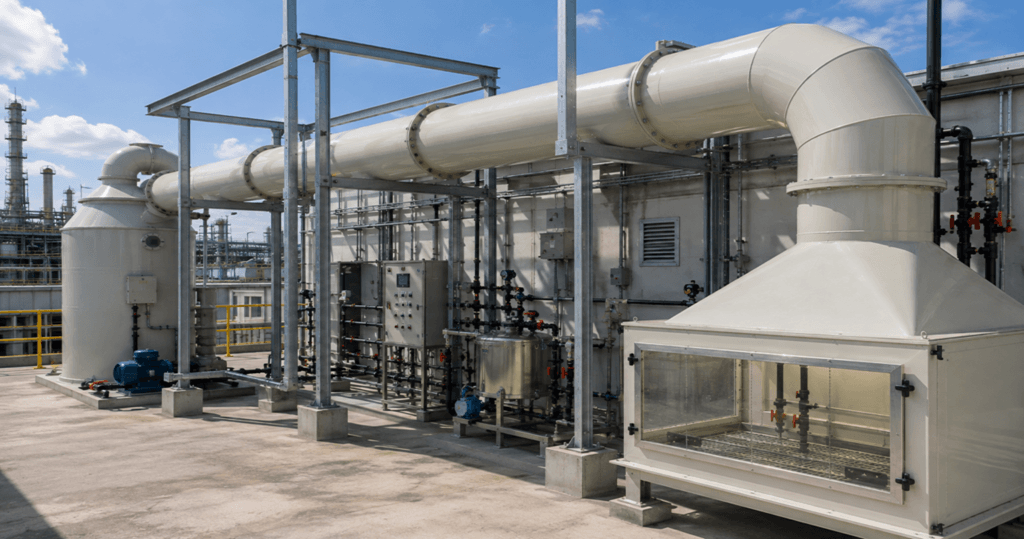
PDI fabricates engineered PVC and CPVC duct systems and matching components for corrosive industrial ventilation, including 90° elbows, reducers, saddle blast gates, and butterfly dampers. The same service assumptions used to select the duct material should be applied to those components as well as seals, gaskets, and connected equipment.
A chemically resistant straight run does not solve the problem if a critical transition or control component contains a material that is incompatible with the exhaust.
When PVC May Not Be the Right Material
Another material should be evaluated when the manufacturer chart lists the process chemical as unsuitable or only conditionally resistant under the expected conditions, when temperature approaches PVC’s practical upper range, or when concentration varies widely during normal operation.
Uncertain mixtures, solvents, aggressive condensate, very large duct, or unusual structural demands can also change the decision. CPVC can extend the useful temperature range of thermoplastic duct, but it is not universally more chemically resistant in every service. FRP can be engineered with different resin systems, but the selected resin still needs to match the actual chemistry.
PDI’s PVC vs. CPVC vs. FRP material-selection guide is the appropriate next resource when temperature, chemistry, size, and structural requirements need to be weighed together. The corrosion-resistant duct selection guide provides a broader application-level framework for evaluating the exhaust environment.
A Practical PVC Chemical-Resistance Checklist
Before approving PVC duct for corrosive exhaust, document:
- Complete list of expected chemicals and process products.
- Normal and maximum concentrations.
- Normal and peak temperatures, including cleaning cycles.
- Gas, vapor, aerosol, liquid-carryover, and condensate conditions.
- Duration and frequency of exposure.
- Known mixtures, solvents, additives, and impurities.
- Duct diameter, wall construction, and operating pressure.
- Support spacing and concentrated component loads.
- Materials used in fittings, dampers, seals, gaskets, and connected equipment.
- Reasonably foreseeable future process changes.
Then compare those conditions with current manufacturer chemical-resistance data for the actual PVC material being specified. If the chart does not clearly cover the condition, do not treat an adjacent rating as approval.
The Specification Should Follow the Complete Chemical Service Envelope
PVC duct can be a durable choice for corrosive industrial exhaust when the chemistry fits the material. Its resistance to many acids, bases, salts, and moisture is a major reason it is used across chemical processing, laboratories, wastewater treatment, semiconductor facilities, and other industrial ventilation applications.
The specification should still follow the complete service envelope. Identify the actual chemicals. Confirm concentration. Check compatibility at the real operating temperature. Account for mixtures, impurities, condensate, and cleaning cycles. Review the duct as an installed system rather than an isolated material sample.
When those conditions fit comfortably inside PVC’s capabilities, it can provide corrosion resistance, low weight, and flexible fabrication. When the chemistry or temperature moves outside that range, identifying the limitation before fabrication is far easier than correcting the system after installation.
Not Sure Whether PVC Is Compatible With Your Exhaust Stream?
Send PDI the process chemicals, concentrations, normal and peak temperatures, duct size, and operating conditions through the Request Information form. The engineering team can help determine whether PVC, CPVC, FRP, or another material is the appropriate fit before fabrication begins.