
Corrosion-resistant duct material solves only part of the problem in a chemical exhaust system. PVC and CPVC exhaust ductwork can provide strong resistance to many corrosive environments that quickly degrade metal, but engineers still need to account for what happens when vapor cools, reaches its dew point, and becomes liquid inside the duct.
Why is condensation a concern in corrosive exhaust ductwork?
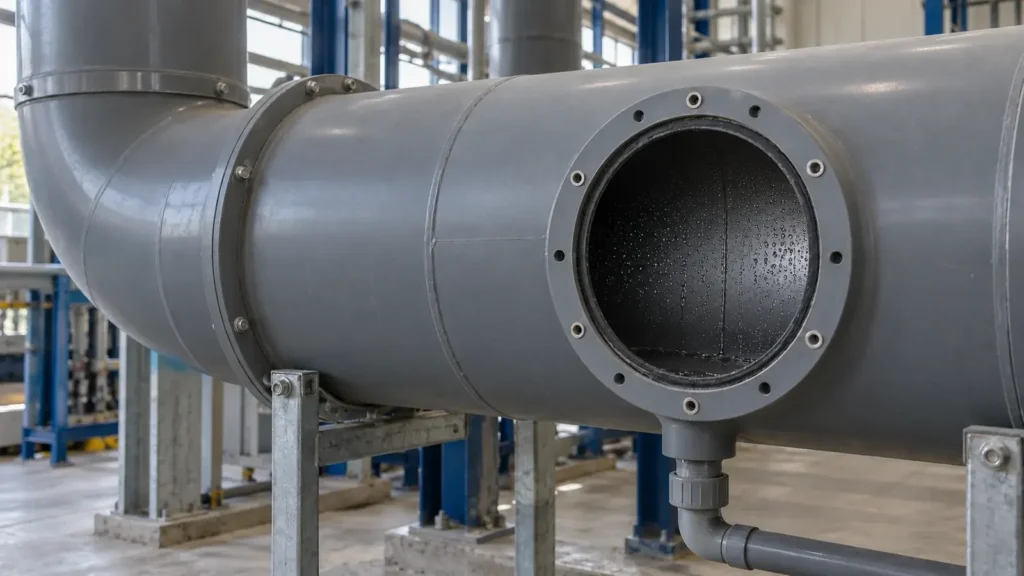
In corrosive exhaust ductwork, cooling can convert moisture and chemical vapors into corrosive liquid condensate that collects at low points in the system. If the duct is not properly sloped and drained, that liquid can become concentrated, expose joints and materials to continuous liquid-phase chemicals, and contribute to leaks, deterioration, or condensate reaching downstream equipment such as the exhaust fan.
The key engineering question is not simply, “Can this duct handle the vapor?”
It is also, “What liquid can form inside this duct, where will it go, and is the system designed to handle it?”
What Causes Condensation in Exhaust Ductwork?
Q: What causes condensation in exhaust ductwork?
A: Condensation occurs when a moisture-containing exhaust stream cools sufficiently for vapor to change into liquid. In chemical exhaust service, the condensate may contain chemicals carried in the exhaust stream rather than being simply water.
Several variables influence whether condensation will occur:
- Exhaust gas temperature
- Moisture or humidity in the airstream
- Chemical species present
- Ambient temperature around the duct
- Temperature changes along the duct run
- Length and configuration of the system
- Intermittent versus continuous operation
- Washdown or other processes that introduce additional moisture
An exhaust stream leaving a process at an elevated temperature may begin above its dew point. As that stream travels through cooler areas of the facility, passes outdoors, or encounters cooler duct surfaces, its temperature can drop enough for condensation to begin.
Startup and shutdown conditions can also matter. A system that operates normally at a stable temperature may experience different conditions while warming up or cooling down.
Where does condensate collect?
Once condensate forms, gravity takes over.
In the field, common collection points include:
- Low spots in horizontal duct runs
- Elbows
- Bottoms of vertical-to-horizontal transitions
- Reducers and other transitions
- Branch connections
- Dead legs
- Improperly supported sections that sag between supports
This is why routing and support design are directly connected to condensate management.
A horizontal run that appears acceptable on a drawing can become a collection point if installed without sufficient slope or if the duct deflects between supports. Likewise, a custom transition may unintentionally create a pocket where liquid cannot drain.
For corrosive exhaust duct, those details should be considered during system design rather than after liquid begins appearing in the installed system.
Can Condensation Damage PVC and CPVC Duct?
Q: Can condensation damage PVC duct?
A: Condensation does not automatically damage PVC or CPVC. The concern is whether the resulting liquid is chemically compatible with the selected thermoplastic at its actual concentration and operating temperature, and whether the system is designed to drain that liquid instead of allowing it to pool.
PVC and CPVC are used extensively in corrosive fume exhaust applications because of their resistance to many acids, caustics, salts, and other chemicals that can be problematic for metallic ductwork.
But “corrosion resistant” does not mean “compatible with every chemical under every condition.”
Three factors must be evaluated together:
- Chemical species
- Chemical concentration
- Temperature
The phase of the chemical also matters.
A material selected based only on vapor exposure may face a different duty when condensate begins coating the interior surface or collecting against a welded joint.
Temperature matters too
As general industry guidance, PVC duct is commonly associated with service temperatures around 140°F (60°C), while CPVC systems may be used at temperatures up to approximately 200°F.
These figures are general guidance, not PDI Duct application-specific ratings. Actual allowable service conditions depend on the material, chemical exposure, concentration, system design, and other operating variables. Specific temperature and chemical compatibility should be verified with PDI engineering for the application.
How Does Condensation Affect Chemical Compatibility?
Q: How does condensation affect chemical compatibility?
A: Condensation changes the exposure from primarily vapor-phase contact to partial or continuous liquid-phase contact. The condensate may contain a higher or changing concentration of process chemicals, so compatibility should be evaluated for the liquid that can actually form, not only for the original exhaust vapor.
This distinction is easy to overlook during material selection.
| Design Consideration | Vapor Exposure | Liquid Condensate Exposure |
|---|---|---|
| Contact with duct | Primarily gas-phase contact. | Direct liquid contact. |
| Contact duration | May move continuously through system. | Can remain at low points. |
| Chemical concentration | Based on exhaust-stream conditions. | May change as vapor condenses. |
| Joint exposure | Primarily internal vapor. | Liquid can sit directly against seams and fittings. |
| Routing sensitivity | Important for airflow. | Critical for drainage. |
| Compatibility review | Vapor conditions considered. | Liquid species, concentration, and temperature must also be considered. |
Consider a process that generates a warm, moisture-laden corrosive exhaust. The duct material may perform well against the moving vapor. But farther downstream, cooling can create droplets on the duct wall.
Those droplets run toward the lowest point available. If that point has no drainage path, the liquid remains there.
Instead of intermittent vapor exposure, the bottom of the duct or fitting may now experience continuous liquid contact.
That is a different service condition.
Do not assume condensate is simply water
This is particularly important in chemical processing, metal plating and finishing, semiconductor manufacturing, laboratories, pharmaceutical facilities, and wastewater applications.
The condensate can contain chemicals carried in the process exhaust.
Before specifying PVC exhaust ductwork or CPVC exhaust duct, engineers should identify not only what enters the exhaust system but also what may condense as the stream cools.
How Do You Prevent Condensate From Collecting in Exhaust Ductwork?
Q: How do you prevent condensate from collecting in exhaust ductwork?
A: Design the system so gravity carries condensate toward an intentional collection or drainage point. This typically requires continuous exhaust duct slope, correctly located low-point drains or drip legs, appropriate fittings and transitions, and supports that prevent horizontal runs from sagging.
Several details deserve attention.
1. Establish a continuous exhaust duct slope
Horizontal duct should not unintentionally trap liquid.
Where condensate is expected, the routing can be designed to pitch toward the process equipment or toward a designated condensate drain, depending on the application and facility requirements.
The important word is continuous.
A specified slope provides little benefit if a fitting, transition, or sagging section interrupts the drainage path.
Information
The required pitch is application-specific and should be established by the system designer based on routing, expected condensate volume, process requirements, and drainage strategy.
2. Identify every low point
Review the entire route, not just straight sections.
Ask:
- Where is the lowest point of each horizontal run?
- What happens at an elbow?
- Does a reducer create a pocket?
- Does a square-to-round transition drain?
- What happens at a branch connection?
- Are there dead legs?
- Could installed support spacing create a sag?
- Where does condensate go immediately before the fan?
If liquid can collect somewhere, that location needs to be addressed during design.
3. Specify low-point drains and drip legs
A low-point drain provides an intentional path for removing accumulated liquid. Depending on the system, engineers may also incorporate drip legs or other condensate collection details.
Drain design needs to consider more than simply adding an opening to the bottom of the duct.
The designer must consider:
- Expected condensate volume
- Chemical compatibility
- Drain location
- Accessibility for inspection and maintenance
- Connection method
- Appropriate trapping or sealing requirements
- Interaction with system pressure
A condensate trap may be required depending on system pressure and drain arrangement so the drain does not become an unintended air path. Trap configuration should be engineered for the operating conditions of the system.
4. Design transitions for drainage
Custom fittings deserve particular attention.
A square-to-round transition, offset, reducer, or unusual retrofit fitting may satisfy the airflow geometry while unintentionally creating a liquid pocket.
For chemical exhaust ductwork where condensation is expected, drainage should be part of the fitting geometry.
This is one reason to address condensate before fabrication. PDI Duct can fabricate transitions and specialty fittings to the system drawing instead of forcing the routing around an off-the-shelf molded shape.
5. Support the duct to preserve the intended slope
Slope shown on a drawing is useful only if the installed duct maintains it.
Supports should be suitable for the thermoplastic system and the corrosive environment. Their placement must also prevent excessive sagging that can create unintended low points.
A long horizontal run with insufficient support can effectively create its own condensate trap.
Fabrication Details Engineers Should Specify Up Front
Condensation management becomes easier when the fabricator knows the operating conditions before material is cut and welded.
For corrosive exhaust applications, PDI Duct needs more than a duct diameter and fitting list.
1. Operating temperature and expected temperature changes
Provide the normal operating temperature as well as significant temperature variations.
Consider:
- Temperature entering the duct
- Expected downstream temperature
- Ambient conditions
- Indoor-to-outdoor transitions
- Startup and shutdown conditions
These values help identify where dew-point conditions may occur.
2. Chemical species and concentration
Identify the chemicals carried by the exhaust and their expected concentrations.
If condensate is possible, consider the composition of the liquid phase, not only the vapor phase.
This information is necessary for meaningful material compatibility review.
3. Moisture content or humidity
A warm exhaust stream with significant moisture behaves differently from a relatively dry stream.
Provide known humidity, water-vapor loading, process moisture, or other information that can help establish condensation potential.
4. Horizontal and vertical routing
Provide enough information to understand the complete drainage path, including:
- Horizontal run lengths
- Vertical rises and drops
- Elbows
- Branches
- Wyes and tees
- Reducers
- Equipment connections
- Transitions
- Elevation changes
PDI Duct fabricates standard round PVC and CPVC duct in 6-inch through 24-inch diameters, with custom sizes and rectangular or square configurations available on request. Specialty fittings and square-to-round transitions can be fabricated to suit the actual routing.
5. Washdown and intermittent operation
Tell the fabricator if the system experiences washdown, cleaning cycles, batch processes, frequent shutdowns, or other operating modes that can introduce liquid or create large temperature changes.
The worst condensate condition may not occur during normal steady-state operation.
Specify drainage details before fabrication
PDI Duct uses hot-air and extrusion welding to fabricate thermoplastic ductwork and fittings to specification.
For a system expected to handle condensate, drainage connections and low-point details are better addressed as part of the fabricated assembly rather than treated as an improvised field modification.
This allows the location, geometry, material, and joining method to be considered with the rest of the fitting.
Welded construction also gives engineers flexibility when a catalog fitting does not match the drainage requirements of a particular installation. Solvent-cement joining may have applications in thermoplastic systems, particularly in smaller sizes, but it should not be treated as a universal substitute for engineered welded fabrication.
When to Call the Fabricator
Bring the fabricator into the discussion early when condensation could influence the duct geometry.
That is especially useful when:
- A horizontal corrosive exhaust run is long or complex
- The system crosses areas with significantly different temperatures
- A process exhaust contains substantial moisture
- Liquid-phase chemical compatibility is uncertain
- A low-point drain needs to be incorporated into a fitting
- A standard transition would create a collection point
- Existing ductwork has recurring leaks near elbows or low points
- A retrofit requires an unusual offset, transition, or connection
- Condensate is reaching downstream equipment
- Off-the-shelf molded fittings do not match the required routing
PDI Duct is the ductwork division of Plastic Design Industries, which has fabricated industrial plastics since 1976. PVC and CPVC ductwork is fabricated directly in our ISO 9001:2015, ANAB-accredited shop, including elbows, wyes, tees, reducers, couplings, end caps, blast gates, butterfly dampers, transitions, and specialty fittings.
The direct-fabricator model also means an engineer can discuss an unusual condensate detail with the people responsible for fabricating it.
What to Provide PDI Duct for a Quote
For a corrosive exhaust duct system where condensation is possible, provide as much of the following as available:
- Duct diameter or dimensions
- PVC or CPVC preference, if already specified
- Chemical species in the exhaust stream
- Expected vapor concentrations
- Expected condensate composition and concentration, if known
- Normal and maximum operating temperatures
- Expected temperature changes along the system
- Moisture or humidity information
- Horizontal run lengths
- Vertical routing and elevation changes
- Required exhaust duct slope
- Proposed low-point drain locations
- Expected condensate volume, if known
- Washdown requirements
- Continuous or intermittent operating conditions
- Fitting and transition requirements
- Drawings, sketches, or existing-system photographs
The more accurately the operating conditions are defined before fabrication, the easier it is to design the duct and fittings around the actual service rather than correct condensate problems after installation
Talk to a Fabricator at PDI Duct
Condensation should be treated as a design condition in corrosive exhaust systems, not an installation surprise.
Have your specs ready?
If you are designing a new PVC or CPVC exhaust system, replacing corroded ductwork, or troubleshooting condensate collection in an existing system, talk to a fabricator at PDI Duct about the routing, chemical exposure, temperatures, and drainage requirements before the fittings are fabricated.
Request a Quote directly from PDI Duct, fabricating industrial plastics in New England since 1976.
Download PDI Duct submittals for product dimensions and planning information when developing your system layout.
Frequently Asked Questions
What causes condensation in exhaust ductwork?
Condensation occurs when a moisture-containing exhaust stream cools enough for vapor to become liquid. In corrosive exhaust systems, that liquid may contain acids, caustics, salts, or other process chemicals carried by the original exhaust stream.
Can condensation damage PVC duct?
Condensation does not automatically damage PVC duct. The resulting liquid must be chemically compatible with PVC at the actual concentration and temperature. Pooling should also be avoided because it can create prolonged liquid-phase exposure at duct walls, fittings, and joints.
How do you prevent condensate from collecting in exhaust ductwork?
Provide a continuous drainage path using appropriate duct slope, intentional low points, condensate drains or drip legs, properly designed fittings, and supports that prevent horizontal duct from sagging. Drain and trap arrangements should be engineered for the specific system conditions.
How does condensation affect chemical compatibility?
Condensation can change chemical exposure from vapor-phase contact to direct liquid contact. Because condensate composition and concentration may differ from the vapor stream, material compatibility should be verified for the expected liquid, its concentration, and its temperature.
Should condensate drains be added during duct fabrication?
When condensate is expected, drainage connections and low-point details are best considered before fabrication. Incorporating them into the original fitting or duct design allows the fabricator to account for drainage geometry, material compatibility, joining method, and accessibility instead of relying on an improvised field modification.