
Specifying corrosion resistant duct is a decision that either disappears quietly into a twenty year service life or comes back as an emergency shutdown in thirty months. A fume hood pulling hydrochloric acid vapor, a plating line venting chromic acid mist, a wastewater headworks carrying hydrogen sulfide: every one of these streams attacks galvanized or stainless duct, and in aggressive acid service metal can perforate in two or three years.
Plastic ductwork solves that, but not with a single material. PVC, CPVC and FRP cover most industrial exhaust, and polypropylene and PVDF cover the edges. This guide covers where each one wins, the process conditions that drive the choice, and the fire code issue that stops more plastic duct projects than any other.
Why Metal Fails and Plastic Does Not
Steel corrodes because it reacts. Introduce an acid vapor, a chloride, or a condensing electrolyte and you have created an electrochemical cell inside the duct. Galvanizing buys time by sacrificing zinc, but once the coating is consumed the base metal is exposed. Stainless resists many environments yet stays vulnerable to chlorides, which are present in a large share of industrial exhaust. Thermoplastics and thermoset composites avoid the mechanism entirely, because there is no metal to oxidize. The failure mode moves from chemical attack to thermal and mechanical limits, which are predictable and easy to design around.
PVC Duct: The Industrial Default
For most corrosive exhaust, PVC is the correct starting point. Duct grade PVC is typically fabricated from material meeting ASTM D1784 cell classification 12454, the classification system covering rigid PVC and CPVC compounds. It resists a broad range of acids, alkalis and salts at ambient and moderately elevated temperatures.
Where PVC wins
- Chemical breadth. It handles most common acid and alkali fume streams without a resin selection exercise.
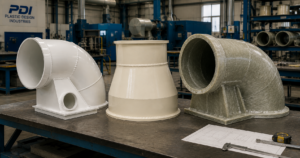
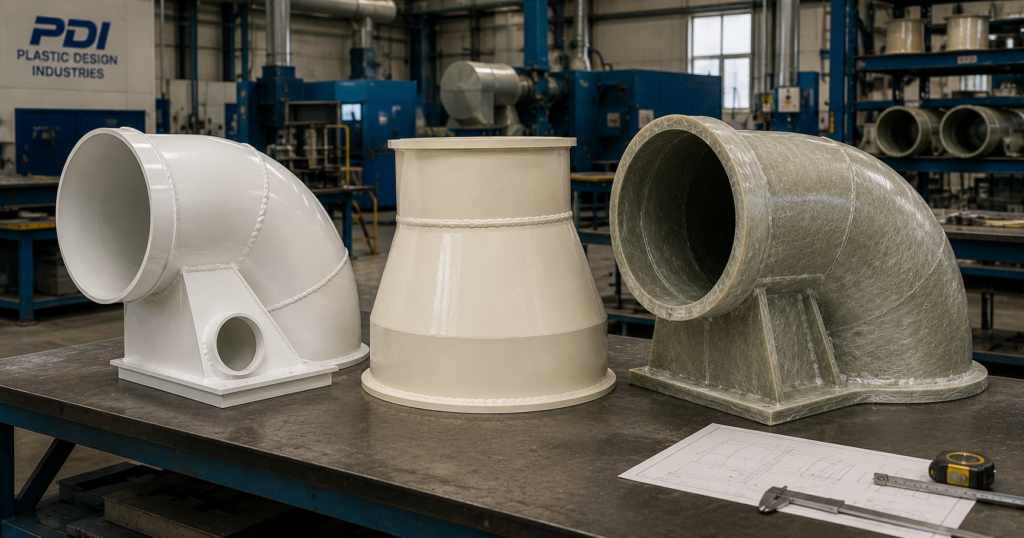
- Fabrication flexibility. PVC is thermally welded and readily modified, so fittings such as elbows, wye branches and reducers can be built to your exact geometry rather than forced into stock configurations.
- Cost and lead time. It is the least expensive of the plastics and usually the fastest to deliver.
- Serviceability. When a process line is reconfigured, PVC duct can be cut into and re-welded without specialty trades.
Where PVC runs out of room
- Temperature. Continuous service is limited to about 140F. PVC does not fail dramatically above that. It softens, sags between supports, and loses pressure rating.
- UV exposure. Unprotected PVC degrades in sunlight, so exterior runs need pigmented material or a UV resistant coating.
- Thermal expansion. PVC moves several times more than steel, so long runs require expansion provisions and correct support spacing.
CPVC Duct: When Heat Is the Constraint
CPVC is PVC that has undergone additional chlorination, which raises the glass transition temperature and pushes continuous service to roughly 200F. Chemical resistance is broadly similar to PVC and superior in several hot acid services, and CPVC generally delivers better flame spread and smoke developed performance.
Specify it when the stream runs hot, such as heated acid etch tanks or hot scrubber discharge, or when code or the insurer demands better flame performance than PVC provides. The trade off is cost. Specifying CPVC across an entire system when only one branch runs hot is a common and expensive error. Many well designed systems are hybrid: CPVC on the hot branch, PVC everywhere else, with a properly engineered transition.
FRP Duct: When Size and Strength Govern
Fiberglass reinforced plastic duct, commonly specified as FRP duct or FRP ductwork, is a thermoset composite rather than a thermoplastic. It is a resin matrix reinforced with glass fiber, built up in layers over a corrosion barrier veil.
Where FRP ductwork earns its premium
- Large diameters. As diameter grows, plastic ductwork needs more structural stiffness, and the strength to weight ratio of FRP makes it the practical choice for large diameter mains.
- High temperature and structural loading. With a vinyl ester resin, FRP serves above the CPVC range, and its rigidity is an advantage where external pressure, vacuum, wind or snow load governs.
What FRP asks of you in return
- Resin selection becomes a design responsibility. Chemical resistance is not a property of FRP as a category. It is a property of the specific resin and veil, and the wrong resin produces an expensive duct that still fails.
- Field modification is difficult. Cutting into an FRP system and restoring the corrosion barrier requires skilled laminators, not a maintenance technician.
- Cost and lead time are the highest of the mainstream options.
Polypropylene and PVDF: The Materials Most Comparisons Skip
Two more thermoplastics appear regularly in real specifications and are usually left out of the comparison.
Polypropylene handles roughly 180F with very broad chemical resistance, particularly against solvents that attack PVC. It is common in scrubbers and semiconductor exhaust. The catch is fire performance: standard polypropylene burns readily and drips, so flame retardant grades and additional fire protection are usually required.
PVDF sits at the top of the range. It handles roughly 280F, resists strong oxidizers and hot acids that defeat everything else, and has excellent inherent flame and smoke characteristics. It is also the most expensive option by a wide margin. If your process defeats PVC and CPVC on chemistry rather than on temperature or diameter, evaluate these before defaulting to FRP. PDI fabricates in polypropylene and PVDF as well as PVC and CPVC, so the material conversation does not have to end at the edge of one product line.
Comparing the Five Materials
| Factor | PVC | CPVC | FRP | Polypropylene | PVDF |
|---|---|---|---|---|---|
| Max service temp | About 140F | About 200F | 200F to 250F, resin dependent | About 180F | About 280F |
| Chemical resistance | Broad: acids, alkalis, salts | Broad, including hotter acids | Depends on resin and veil | Very broad, strong on solvents | Highest, handles oxidizers |
| Flame and smoke | Good, verify ASTM E84 rating | Generally better than PVC | Varies by resin | Poor unless flame retardant grade | Excellent, inherently low |
| Large diameters | Limited | Limited | Best in class | Limited | Limited |
| Field modification | Easy | Easy | Requires laminators | Easy | Specialist welding |
| Relative cost | Lowest | Moderate | High | Moderate | Highest |
Typical industry figures. Confirm against manufacturer data and the chemical resistance chart for your specific process stream.
TECHNICAL SPEC: THERMOPLASTIC DUCT SERVICE LIMITS AND THERMAL MOVEMENT Continuous service temperature. PVC: about 140F. Polypropylene: about 180F. CPVC: about 200F. PVDF: about 280F. Design to the excursion temperature, not the average. A process that upsets to 160F for twenty minutes a week rules out PVC even when normal operating temperature is 110F. Thermal expansion. PVC has a coefficient of linear thermal expansion of roughly 2.9 x 10^-5 in/in/F, several times that of carbon steel. Worked example. A 100 ft PVC run seeing a 50F temperature swing moves about 1.7 inches. Without expansion provisions that movement buckles duct, stresses joints and pulls hangers. Support spacing. Spacing for plastic duct is not the same as for metal duct, and it tightens as service temperature rises. Verify all figures against the manufacturer data for the specific product before final design. |
The Fire Code Question That Stops Plastic Duct Projects
This derails more plastic ductwork specifications than temperature and chemistry combined, and it is usually discovered late. Plastic duct burns, and that single fact drives a body of code and insurance requirements many project teams do not investigate until the design is nearly complete. NFPA 91, the standard for exhaust systems conveying vapors, gases, mists and particulate solids, sets minimum requirements for design, construction, installation and maintenance. Property insurers apply their own data sheets on top of that, and those frequently call for automatic sprinkler protection inside nonmetallic duct or restrict where it may be used at all.
None of this makes plastic duct unusable. It is installed successfully every day. It does mean three things:
- Confirm fire protection requirements with the authority having jurisdiction and with the property insurer before the material is selected, not after.
- Budget for in duct sprinklering if it is required. Retrofitting it costs significantly more than designing it in.
- Ask for the actual ASTM E84 test data for the specific product you intend to buy, rather than accepting a general claim about the material category.
Five Specification Mistakes That Cause Premature Failure
- Designing to average temperature instead of excursion temperature. This is the leading cause of sagging, deformed thermoplastic duct.
- Ignoring thermal expansion and support spacing. Plastic duct moves, and long straight runs without expansion provisions will buckle.
- Forgetting the accessories. Duct is only part of the system. Blast gates and dampers sit in the same corrosive stream and must be specified in a compatible material. A PVC run with a metal blast gate has a metal blast gate as its failure point.
- Leaving exterior PVC unprotected. It will chalk, embrittle and crack.
- Specifying FRP by name rather than by resin. The letters FRP tell you almost nothing about whether the duct will survive your chemistry.
The Bottom Line
For most corrosive exhaust, PVC is the right place to start: chemically broad, cost effective, easy to fabricate and easy to modify. Move to CPVC when temperature or flame spread requirements exceed what PVC delivers. Move to polypropylene or PVDF when chemistry rather than temperature is the obstacle. Move to FRP when diameter, structural loading or extreme service genuinely demand it, and when you are prepared to engage seriously with resin selection and fire protection.
Frequently Asked Questions
What temperature can PVC duct handle?
Duct grade PVC is rated for continuous service up to about 140F. Above that it softens and sags rather than failing suddenly. For hotter streams, CPVC extends service to roughly 200F. Design to the peak excursion temperature, not the average operating temperature.
What is FRP duct?
FRP duct, or fiberglass reinforced plastic ductwork, is a thermoset composite made from a resin matrix reinforced with glass fiber over a corrosion barrier veil. It is used where large diameters, high structural loading or elevated temperatures exceed what thermoplastic duct can handle. Its chemical resistance depends entirely on the specific resin, not on the fact that it is FRP.
Which is better, PVC duct or FRP duct?
Neither is universally better. PVC is less expensive, easier to fabricate and easier to modify, and it suits most small to mid diameter corrosive exhaust. FRP is stronger and stiffer, handles larger diameters and higher temperatures, and costs significantly more. The correct choice depends on temperature, diameter, structural loading and chemistry.
Working Through a Material Selection?
PDI has fabricated PVC and CPVC duct and piping systems for industrial and laboratory exhaust since 1976. Send us your process conditions, including chemistry, concentration, peak temperature, diameter and pressure, and we will help you scope it. Chemistry and code requirements are a cheap conversation. A replacement duct run is not. Request a quote.