

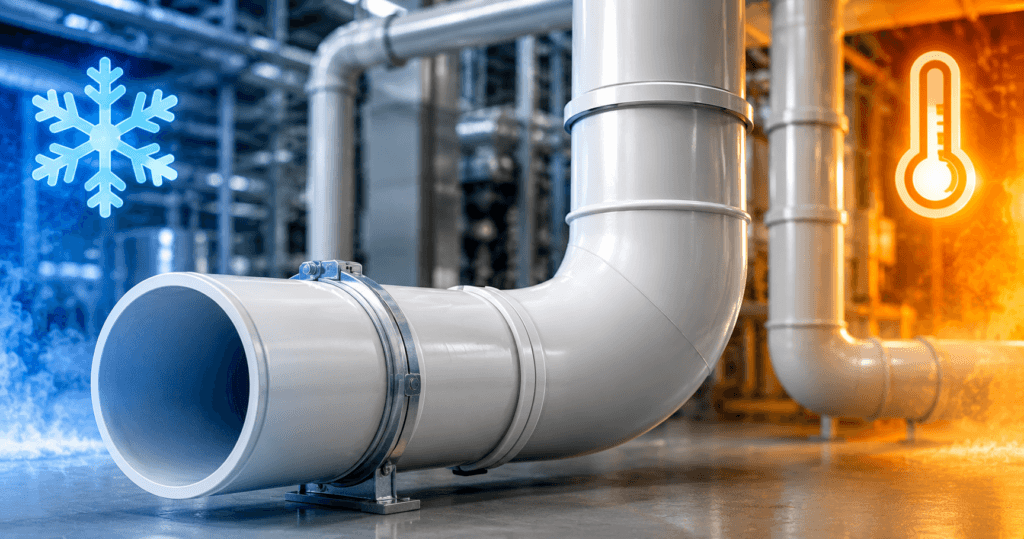
What Are the PVC Duct Temperature Limits?
For rigid industrial ventilation duct, manufacturers commonly publish a maximum temperature rating of approximately 140°F (60°C) for PVC. Spears lists a 140°F maximum rating for extruded PVC duct and 200°F for CPVC duct, while IPEX identifies CPVC ventilation duct for exhaust temperatures up to 200°F.
That temperature difference creates a useful material-selection boundary. PVC is well suited to many ambient and moderate-temperature corrosive exhaust applications. CPVC becomes the next material to evaluate when the process runs hotter but still fits within the practical range of thermoplastic duct.
| Material | Typical Maximum Service Temperature | General Use |
|---|---|---|
| PVC | 140°F (60°C) | Moderate-temperature corrosive exhaust |
| CPVC | 200°F (93°C) | Higher-temperature corrosive exhaust |
The published rating should still be checked against the exact material, duct construction, fabrication method, and project requirements. A PVC system operating at 135°F should not be treated as equivalent to one operating at 75°F simply because both are below the same maximum rating
Why Temperature Changes the Specification
PVC does not suddenly become unusable at a single temperature. Its mechanical behavior changes progressively as temperature rises. Published thermoplastic engineering data show that elevated temperature reduces available mechanical margin, and pressure-rated PVC piping is derated as service temperature increases.
For ductwork, the practical implication is broader than a piping pressure-derating table. Engineers should review temperature together with duct diameter, wall construction, positive or negative operating pressure, horizontal span, support spacing, connected equipment, and concentrated fitting loads. A large horizontal run near a hot process connection can behave very differently from a short straight section at the same temperature.
Temperature also affects movement. PVC expands when heated and contracts when cooled, so long runs and fixed equipment connections should be laid out and supported with the expected temperature range in mind. Manufacturer guidance for thermoplastic systems consistently treats operating temperature, support spacing, and thermal expansion as connected design considerations.
Check Operating Temperature and Peak Temperature Separately
Industrial exhaust rarely stays at one exact temperature throughout the day. Startup, shutdown, batch changes, cleaning cycles, equipment faults, or loss of dilution air can create short-duration peaks above the normal process condition.
Consider a system that normally operates at 115°F but reaches 150°F during a recurring process upset. Designing only around the 115°F value would ignore the event that actually exceeds the normal PVC temperature rating. A similar issue can occur locally when one process branch, elbow, or transition sees a hotter stream than the main duct.
For specification purposes, document at least the highest expected operating temperature and the highest credible upset or cleaning-cycle temperature. Peak duration and frequency should also be recorded. A rare short excursion is not the same as sustained exposure, but recurring temperature events should be reviewed rather than dismissed.
Temperature, Chemistry, and System Loads Work Together
Temperature should not be evaluated by itself in a corrosive exhaust system. Chemical compatibility can change with both concentration and temperature, and no single thermoplastic is suitable for every chemical environment.
A chemical stream that is compatible with PVC near ambient temperature may require a different material decision when it becomes hotter or more concentrated. The specification should therefore identify the exhaust constituents, concentration range, normal and peak temperatures, moisture or condensate, process variability, and any cleaning chemicals introduced into the system.
Once chemistry has been checked, mechanical conditions still matter. Larger duct diameters, longer horizontal spans, connected equipment, and concentrated loads around fittings can reduce available design margin at elevated temperature. For projects where temperature, chemistry, size, and structural requirements are all in play, PDI’s PVC vs. CPVC vs. FRP material-selection guide provides the broader comparison.
Keep the Material Consistent Through Duct, Fittings, and Controls
The material decision should continue through the full exhaust path. If the main run is specified in PVC, fittings and controls exposed to the same stream should be checked against the same service assumptions.
PDI fabricates engineered PVC and CPVC duct systems and matching components for corrosive industrial ventilation. Relevant components include 90° elbows, reducers, saddle blast gates, and butterfly dampers. Material continuity is especially important near process connections and airflow-control points, where temperatures or component loads may be higher.
This also makes the submittal and fabrication package easier to review. Straight duct, direction changes, transitions, and airflow controls can be evaluated against one documented service envelope instead of relying on mixed materials without a clear engineering reason.
What Can Overheating Look Like in PVC Duct?
A temperature-related problem may first appear as a change in the duct’s shape or alignment rather than an immediate rupture. Practical warning signs can include visible sagging between supports, a section becoming out of round, distortion near a fabricated joint or hot process connection, or fittings and controls shifting out of alignment.
Those observations are inspection indicators, not a diagnosis by themselves. Similar symptoms can also result from poor support, excessive loading, or installation issues. If a PVC run shows permanent deformation, the operating history, actual temperatures, support conditions, and connected loads should be reviewed before the section is simply re-supported or forced back into alignment.
When Should You Move From PVC to CPVC?
CPVC is the logical next material to evaluate when standard PVC no longer provides a comfortable temperature margin but the application remains within CPVC’s service range. Typical reasons include:
- Exhaust temperatures that approach or exceed the normal PVC range.
- Recurring process peaks that cross the PVC temperature rating.
- Hot corrosive fumes where a thermoplastic solution is still preferred.
- Applications requiring matching higher-temperature duct, fittings, and airflow controls.
- Future process changes that could reasonably increase exhaust temperature.
The higher temperature rating does not make CPVC automatically better for every project. If PVC comfortably meets the temperature, chemistry, and system-loading requirements, moving to CPVC may add cost without providing a meaningful engineering benefit.
The reverse is also true. If temperatures approach CPVC’s own approximately 200°F upper range, chemical compatibility is uncertain, or duct size and structural demands become unusually high, the material-selection discussion should expand. Depending on the application, FRP or another engineered material may be more appropriate.
A Practical PVC Temperature Checklist
Before approving PVC duct for an industrial exhaust system, document:
- Normal operating temperature.
- Highest expected operating temperature.
- Maximum credible upset or cleaning-cycle temperature.
- Duration and frequency of temperature peaks.
- Exhaust chemistry and concentration.
- Moisture, condensate, and cleaning chemicals.
- Duct diameter and wall construction.
- Positive or negative operating pressure.
- Support spacing and horizontal span.
- Weight of dampers, blast gates, or other concentrated components.
- Equipment connections and expected thermal movement.
- Reasonably foreseeable future process changes.
Review those factors together rather than treating 140°F as a stand-alone pass/fail number. A moderate-size PVC run at 100°F with compatible chemistry and conservative supports is a very different design condition from a large run close to 140°F with long spans, aggressive chemistry, and heavy airflow-control components.
The Specification Should Follow the Complete Service Envelope
PVC duct is commonly published with a maximum temperature rating of approximately 140°F, making it a practical material for many corrosive industrial exhaust systems. The number is useful, but it is only one part of the specification.
Use the hottest credible process condition rather than the daily average. Check chemical compatibility at temperature. Review duct size, supports, operating pressure, loading, and thermal movement. Keep elbows, reducers, blast gates, dampers, and other components consistent with the material logic used for the main duct.
When those conditions fit comfortably inside PVC’s capabilities, PVC can provide a useful combination of corrosion resistance, low weight, low maintenance, and custom fabrication. When temperature begins to remove that margin, evaluating CPVC before fabrication is far easier than correcting a system after installation.
Not Sure Which Material Your Application Calls For?
Send PDI the normal and peak operating temperatures, exhaust chemistry, duct diameter, and pressure or vacuum conditions. The engineering team can help determine whether PVC, CPVC, or another material is the appropriate fit before fabrication begins.